

We have entered the age of data 4.0. It all happened so fast, in just a decade: with date 1.0 we use data to drive specific business applications. Then we evolved to Data 2.0, a time when data aggregation was already geared towards supporting business processes across the organization. With date 3.0, data began to drive our digital transformation processes.
Today, already at the dawn of Data 4.0, Data management takes on a dimension"Dimension" It is a term that is used in various disciplines, such as physics, Mathematics and philosophy. It refers to the extent to which an object or phenomenon can be analyzed or described. In physics, for instance, there is talk of spatial and temporal dimensions, while in mathematics it can refer to the number of coordinates necessary to represent a space. Understanding it is fundamental to the study and... Truly strategic.
What's more, artificial intelligence (HE) Y machine learning (ML) Carrying out intelligent and automated information management in Cloud environments is increasingly the starting point to remain competitive and achieve a analytical advantage. In a context in which companies modernize their analyticsAnalytics refers to the process of collecting, Measure and analyze data to gain valuable insights that facilitate decision-making. In various fields, like business, Health and sport, Analytics Can Identify Patterns and Trends, Optimize processes and improve results. The use of advanced tools and statistical techniques is essential to transform data into applicable and strategic knowledge.... Big Data in the Cloud, the cloud data warehouses, data lakes Y lake houses play a fundamental role.
Read also: Data strategy: We are prepared to Date 4.0?

Of course, this scenario is not without its challenges. One study found that 64% of organizations struggle with data management issues. And to really reap the benefits of cloud data warehouses, data lakes Y lake houses, need to evolve towards a intelligent data management in the native Cloud.
3 pillars for intelligent and automated data management
To obtain successful results in the world of Data 4.0, it is necessary to develop the three basic pillars of data management in the native Cloud, what are the following:

√ Metadata management, that allows you to catalog, efficiently discover and understand how data moves through the organization.
√ Data integration, which offers support for bulk file ingest, databases and data transmission from the Internet of things (IoT) to fill the data lakes, optimize and process them in the Cloud.
√ Data quality, enabling reliable data delivery through comprehensive profiles, rule generation, data dictionary and more.
Many companies already understand the central role that data plays.

Consulted on the strategic areas of your organization during the next 5 years, the 80% of respondents mentioned the use of data in advanced decision models.
Source: IDC
In another investigation by the same consulting firm, 67% prioritized building a data management capability that enables them to turn internal data into information through organization, the maintenance and refinement of data sets and processes. But nevertheless, according to the report, the 45% of organizations were still at a low level (1 Y 2) maturity for data excellence; only the 19% had reached the highest level 5.
You may be interested in continuing reading: Having a data strategy in the digital age is no longer an option
Way forward
Secondly, other statistical work found that the 95% of organizations see negative impacts of poor data quality, resulting in wasted resources and additional costs. On average, organizations believe that 29% of your data is inaccurate. And the 89% have difficulty managing data quality, what affects its overall value (this means everything, from relying on data to accessing and leveraging it effectively).
As you can see, to move towards the new paradigm of Data 4.0, intelligent data management powered by AI, There is much work to be done. But it is an inevitable evolution: Only the intelligent and automated data fabric will ensure that organizations deliver the results and innovations necessary for their digital transformation.
The road presents challenges. But the prize that this evolution promises is more than attractive.
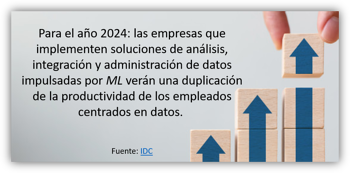
To succeed in this new scenario Data 4.0, the development of the three aforementioned pillars is required, which can be incorporated through strategic alliances with specialized partners that help us enter this new cloud native world, driven by metadata, backed by intelligent automation and reliable information. A world in which the scale, the necessary automation and trust can only be achieved with the capabilities of artificial intelligence and machine learning.
Are you moving towards intelligent data management in your organization?
(function(d, s, id) {
var js, fjs = d.getElementsByTagName(s)[0];
if (d.getElementById(id)) return;
js = d.createElement(s); js.id = id;
js.src = “//connect.facebook.net/es_ES/all.js#xfbml=1&status=0”;
fjs.parentNode.insertBefore(js, fjs);
}(document, ‘script’, 'facebook-jssdk'));