
Overview
- Understand Spark Streaming and how it works.
- Learn about Windows on Spark Streaming with an example.
Introduction
According to IBM, the 60% of all sensory information loses value in a few milliseconds if it is not acted upon. Taking into account that the Big Data and analytics market has reached the $ 125 billion and a large part of this will be attributed to IoT in the future, inability to harness information in real time will result in billions of dollars of loss.
Examples of some of these applications include a telecommunications company, which calculates how many of its users have used WhatsApp in the last 30 minutes, a retailer that tracks the number of people who have said positive things about their products today on social media, or a law enforcement agency looking for a suspect using CCTV traffic data.
Esta es la razón principal por la que los sistemas de procesamiento de flujos como Spark Streaming definirán el futuro de la analyticsAnalytics refers to the process of collecting, Measure and analyze data to gain valuable insights that facilitate decision-making. In various fields, like business, Health and sport, Analytics Can Identify Patterns and Trends, Optimize processes and improve results. The use of advanced tools and statistical techniques is essential to transform data into applicable and strategic knowledge.... in real time. There is also a growing need to analyze both data at rest and data in motion to power applications., what makes systems like Spark, they can do both, be even more attractive and powerful. It is a system for all Big Data seasons.
You will learn how Spark Streaming not only keeps the familiar Spark API intact, but also, underhood, uses RDD for storage and fault tolerance. This allows Spark professionals to jump into the streaming world right from the start.. With that in mind, let's get right to it.
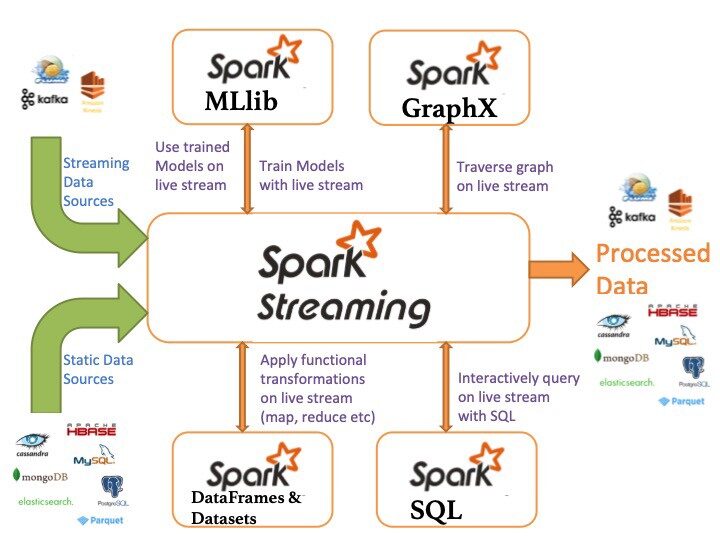
Introducción a Spark Streaming | de Harshit Agarwal | Half
Table of Contents
- Apache SparkApache Spark is an open-source data processing engine that enables the analysis of large volumes of information quickly and efficiently. Its design is based on memory, which optimizes performance compared to other batch processing tools. Spark is widely used in big data applications, Machine Learning and Real-Time Analytics, thanks to its ease of use and...
- Ecosistema Apache Spark
- Spark Streaming: DStreams
- Spark Streaming: transmission context
- Example: word count
- Spark Streaming: Window
- A window based on: word count
- a (more efficient) window based: word count
- Spark Streaming: exit operations
Apache Spark
Apache Spark is a unified computing engine and set of libraries for parallel data processing in computer clusters. At the time of writing this article, Spark is the most developed open source engine for this task, making it a standard tool for any developer or data scientist interested in big data.
Spark supports several widely used programming languages (Python, Java, Scale y R), includes libraries for various tasks ranging from SQL to streaming to machine learning, and runs anywhere, desde una computadora portátil hasta un clusterA cluster is a set of interconnected companies and organizations that operate in the same sector or geographical area, and that collaborate to improve their competitiveness. These groupings allow for the sharing of resources, Knowledge and technologies, fostering innovation and economic growth. Clusters can span a variety of industries, from technology to agriculture, and are fundamental for regional development and job creation.... de miles de servidores. This makes it an easy system to get started and scale up to big data processing or incredibly large scale.. Here are some of the features of Spark:
-
Fast, general-purpose engine for large-scale data processing
-
Spark can efficiently support more types of calculations
-
Can read / write to any Hadoop-compatible system (for instance, HDFSHDFS, o Hadoop Distributed File System, It is a key infrastructure for storing large volumes of data. Designed to run on common hardware, HDFS enables data distribution across multiple nodes, ensuring high availability and fault tolerance. Its architecture is based on a master-slave model, where a master node manages the system and slave nodes store the data, facilitating the efficient processing of information..)
- Speed: in-memory data storage for very fast iterative queries
-
el sistema también es más eficiente que MapReduceMapReduce is a programming model designed to efficiently process and generate large data sets. Powered by Google, This approach breaks down work into smaller tasks, which are distributed among multiple nodes in a cluster. Each node processes its part and then the results are combined. This method allows you to scale applications and handle massive volumes of information, being fundamental in the world of Big Data.... para aplicaciones complejas que se ejecutan en el disco
-
until 40 times faster than Hadoop
-
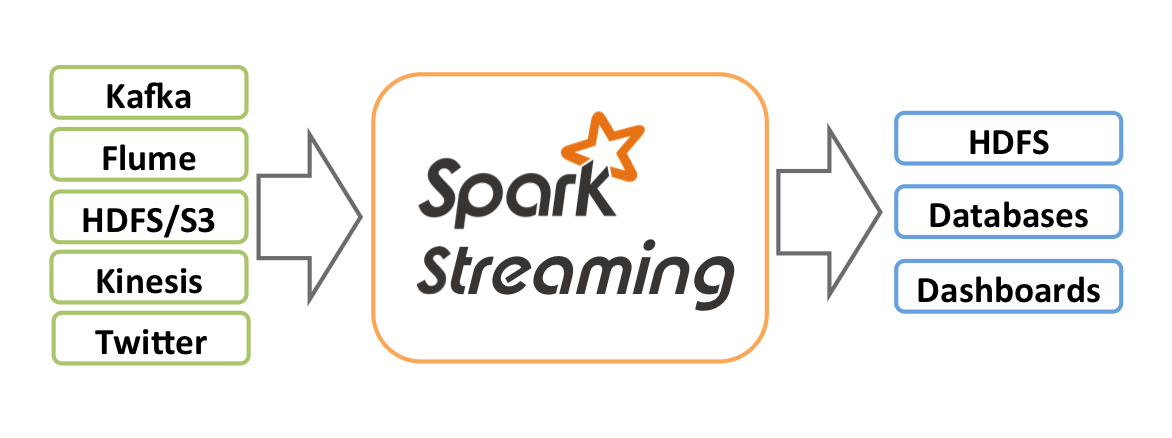
Ingest data from many sources: Kafka, Twitter, HDFS, sockets TCP
-
Results can be sent to file systems, databases, live panels, but not only
-
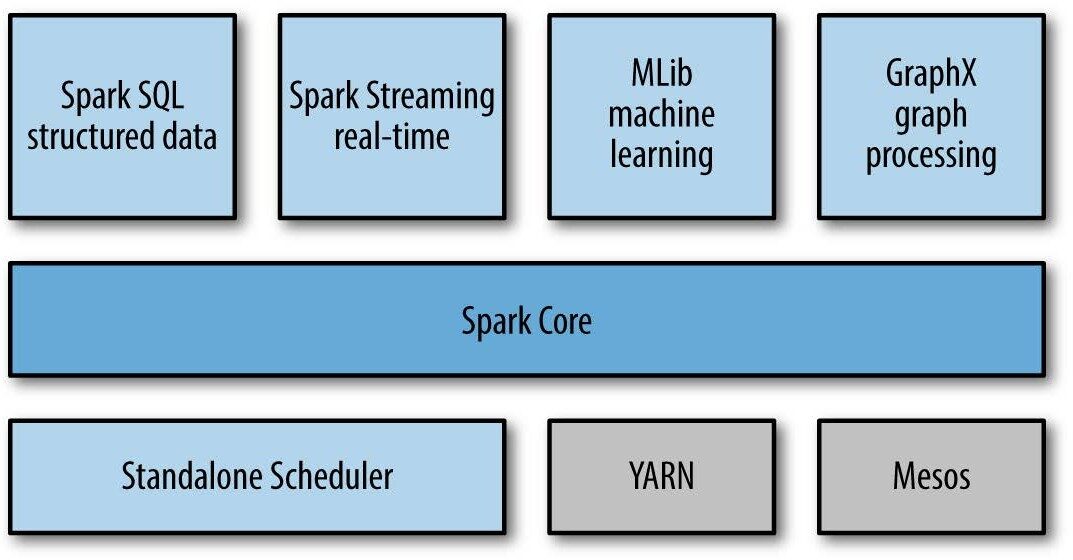
Ecosistema Apache Spark
The following are the components of the Apache Spark ecosystem:
- Spark Core: basic Spark functionality (task scheduling, memory management, fault recovery, storage systems interaction).
-
Spark SQL: package to work with structured data queried through SQL and HiveQL
-
Spark Streaming: a component that enables the processing of live data streams (for instance, log files, status update messages)
- MLLib: MLLib is a machine learning library like Mahout. It is built on Spark and has the ability to support many machine learning algorithms.
- GraphX: For graphs and graphical calculations, Spark has its own graphical calculation engine, called GraphX. It is similar to other widely used graphics processing tools or databases, like Neo4j, Giraffe and many other distributed graphics databases.
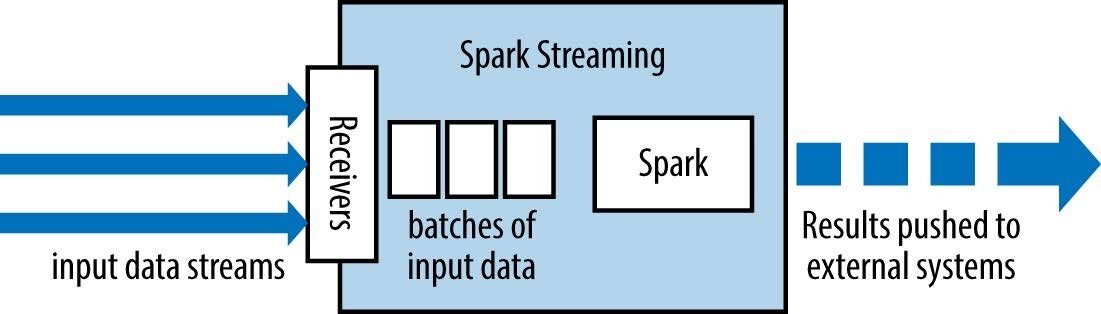
Spark Streaming: abstractions
Spark Streaming has a micro batch architecture as follows:
-
treats the transmission as a series of data batches
-
New batches are created at regular time intervals.
-
the size of the time intervals is called batch break
-
the batch interval is usually between 500 ms and several seconds
The reduction value of each window is calculated incrementally.
Discretized sequence (DStream)
Discretized current O DStream is the basic abstraction provided by Spark Streaming. Represents a continuous flow of data, either the input data stream received from the source or the processed data stream generated by transforming the input stream. Internally, a DStream is represented by a continuous series of RDDs, which is Spark's abstraction of a distributed and immutable dataset (watch Spark Programming Guide for more details). Each RDD in a DStream contains data of a certain interval.
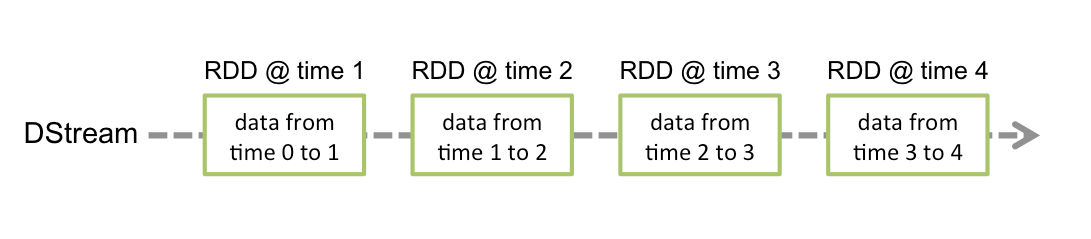
- RDD transformations are calculated by the Spark engine
-
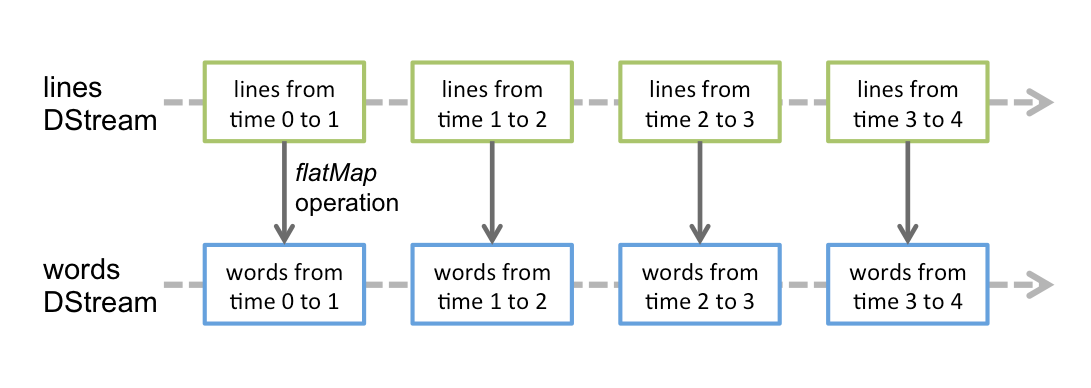
DStream operations hide most of these details
-
Any operations applied in a DStream translate into operations in the underlying RDDs.
-
The reduction value of each window is calculated incrementally.
Spark Streaming: transmission context
It is the main entry point for Spark Streaming functionality. Provides methods used to create DStreams from various input sources. Streaming Spark can be created by providing a Spark Master URL and Application Name, or from an org.apache.spark.SparkConf configuration, o desde un org.apache.spark.SparkContext existente. The associated SparkContext can be accessed using context.sparkContext.
After creating and transforming DStreams, streaming computing can be started and stopped using context.start() Y, respectively. context.awaitTermination() allows current thread to wait for context termination by stop() or for an exception.
To run a SparkStreaming application, we need to define StreamingContext. SparkContext specializes for streaming applications.
The streaming context in Java can be defined as follows:
JavaStreamingContext ssc = new JavaStreamingContext(sparkConf, batchInterval);
where:
-
Maestro is a Spark cluster URL, Mesos o YARNYARN is a package manager for JavaScript that allows the efficient installation and management of dependencies in development projects. Powered by Facebook, It is characterized by its speed and security compared to other managers. YARN uses a cache system to optimize installations and provides a lock file to ensure consistency of dependency versions across different development environments....; to run your code in local mode, use “local[K]"Where K> = 2 represents parallelism
-
app name is the name of your application
-
batch interval time interval (in seconds) of each batch
Once built, offer two types of operations:
Some examples are: map (), filter () y reduceByKey ()
-
-
stateful transformations: uses data from previous batches to calculate the results of the current batch. Include sliding windows, status monitoring over time, etc.
-
Note that a streaming context can be started only once and must be started after we configure all DStreams and output operations.
Basic data sources
The basic Spark Streaming data sources are listed below:
- File streams: Used to read data from files on any file system that supports the HDFS API (namely, HDFS, S3, NFS, etc.), you can create a DStream like:
... = streamingContext.fileStream<...>(directory);
- Streams based on custom receivers: DStreams can be created with data streams received through custom receivers, extending the Receiver class
... = streamingContext.queueStream(queueOfRDDs)
- RDD queue as flow: To test a Spark Streaming application with test data, you can also create a DStream based on an RDD queue, using
... = streamingContext.queueStream(queueOfRDDs)
Most transformations have the same syntax as applied to RDDs
-
Transformation
Sense
Map (func)
Returns a new DStream by passing each element of the source DStream through a func function.
flatMap (func)
Similar to the map, but each input element can be assigned to 0 or more output elements.
filter (func)
Return a new DStream by selecting only the records from the source DStream where func returns true.
Union (otherStream)
Returns a new DStream that contains the union of the elements of the source DStream and otherDStream.
join (another flow)
When two pair DStreams are called (K, V) Y (K, W), returns a new DStream of (K, (V, W)) pairs with all element pairs for each key.
Example: word count
SparkConf sparkConf = new SparkConf()
.setMaster("local[2]").setAppName("WordCount");
JavaStreamingContext ssc = ...
JavaReceiverInputDStream<String> lines = ssc.socketTextStream( ... );
JavaDStream<String> words = lines.flatMap(...);
JavaPairdStream<String, Integer> wordCounts = words
                                             .mapToPair(s -> new Tuple2<>(s, 1))
                                             .reduceByKey((i1, i2) -> i1 + i2);

wordCounts.print();
Spark Streaming: Window
The simplest window function is a window, that allows you to create a new DStream, calculado aplicando los parametersThe "parameters" are variables or criteria that are used to define, measure or evaluate a phenomenon or system. In various fields such as statistics, Computer Science and Scientific Research, Parameters are critical to establishing norms and standards that guide data analysis and interpretation. Their proper selection and handling are crucial to obtain accurate and relevant results in any study or project.... de ventana al antiguo DStream. you can use any of the dstream operations in the new stream, so you get all the flexibility you want.
Calculations in windows allow you to apply transformations over a sliding data window. Any window operation needs to specify two parameters:
- window long
- The duration of the window in seconds.
- sliding break
- The interval at which the window operation is performed in seconds.
- these parameters must be multiples of the batch interval.
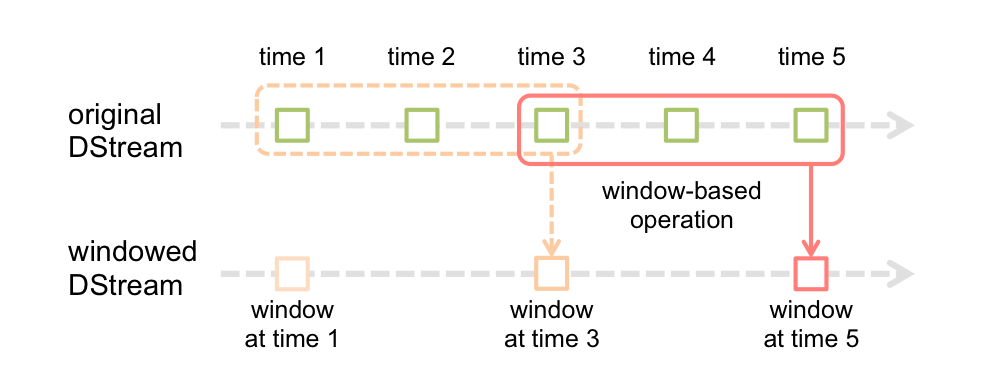
window(windowLength, slideInterval)
Returns a new DStream that is calculated based on batches in window.
...
JavaStreamingContext ssc = ...
JavaReceiverInputDStream<String> lines = ...
JavaDStream<String> linesInWindow =
lines.window(WINDOW_SIZE, SLIDING_INTERVAL);
JavaPairdStream<String, Integer> wordCounts = linesInWindow.flatMap(SPLIT_LINE)
.mapToPair(s -> new Tuple2<>(s, 1))
.reduceByKey((i1, i2) -> i1 + i2);
- reduceByWindow (func, InvFunc, windowLength, slideInterval)
- Returns a new sequence of a single item, created by adding elements in the sequence during a sliding interval using func (which must be associative).
- The reduction value of each window is calculated incrementally.
- reduceByKeyAndWindow (func, InvFunc, windowLength, slideInterval)
- When calling in a DStream of (K, V) Pairs, returns a new DStream of (K, V) pairs where the values for each key are added using the given reduction function func over lots in a sliding window.
To perform these transformations, we need to define a directory of checkpoints
Window-based: word count
...
JavaPairdStream<String, Integer> wordCountPairs = ssc.socketTextStream(...)
.flatMap(x -> Arrays.asList(SPACE.split(x)).iterator())
.mapToPair(s -> new Tuple2<>(s, 1));
JavaPairdStream<String, Integer> wordCounts = wordCountPairs
.reduceByKeyAndWindow((i1, i2) -> i1 + i2, WINDOW_SIZE, SLIDING_INTERVAL);
wordCounts.print();
wordCounts.foreachRDD(new SaveAsLocalFile());
a (more efficient) window based: word count
In a more efficient version, the reduction value of each window is calculated incrementally.
note that checkpoints must be enabled to use this operation.
...
ssc.checkpoint(LOCAL_CHECKPOINT_DIR);
...
JavaPairdStream<String, Integer> wordCounts = wordCountPairs.reduceByKeyAndWindow(
(i1, i2) -> i1 + i2,
(i1, i2) -> i1 - i2, WINDOW_SIZE, SLIDING_INTERVAL);
Spark Streaming: exit operations
Las operaciones de salida permiten que los datos de DStream se envíen a sistemas externos como una databaseA database is an organized set of information that allows you to store, Manage and retrieve data efficiently. Used in various applications, from enterprise systems to online platforms, Databases can be relational or non-relational. Proper design is critical to optimizing performance and ensuring information integrity, thus facilitating informed decision-making in different contexts.... o un sistema de archivos
-
Exit operation
Sense
Print()
Imprime los primeros diez elementos de cada lote de datos en un DStream en el nodeNodo is a digital platform that facilitates the connection between professionals and companies in search of talent. Through an intuitive system, allows users to create profiles, share experiences and access job opportunities. Its focus on collaboration and networking makes Nodo a valuable tool for those who want to expand their professional network and find projects that align with their skills and goals.... from the controller that runs the application.
saveAsTextFiles (prefix, [suffix])
Save the content of this DStream as text files. The filename in each batch interval is generated based on the prefix.
saveAsHadoopFiles (prefix, [suffix])
Save the contents of this DStream as Hadoop files.
saveAsObjectFiles (prefix, [suffix])
Save the content of this DStream as SequenceFiles of serialized Java objects.
foreachRDD (func)
Generic output operator that applies a function, func, to each RDD generated from the sequence.
Online References
• Spark Documentation
• Spark Documentation
Conclution
It should be clear that Spark Streaming presents a powerful way of writing streaming applications. Taking a batch job that you are already running and converting it to a streaming job with almost no code changes is simple and extremely useful from an engineering point of view if you need this job to interact closely with the rest of your processing application. data.
I recommend that you consult the following data engineering resources to improve your knowledge:
If you liked the article, leave a comment in the comment section below.